
How to Measure Influencer Marketing ROI Without Trusting One Number
A practical guide to influencer marketing ROI measurement using links, promo codes, surveys, cost definitions, creator scorecards, and decision-ready reporting.
In this guide
Measuring influencer marketing ROI is not as simple as dividing attributed revenue by the creator fee. A useful ROI system answers three questions: what business outcome did the creator partnership influence, how confident are we in the attribution, and what should we do with the next dollar?
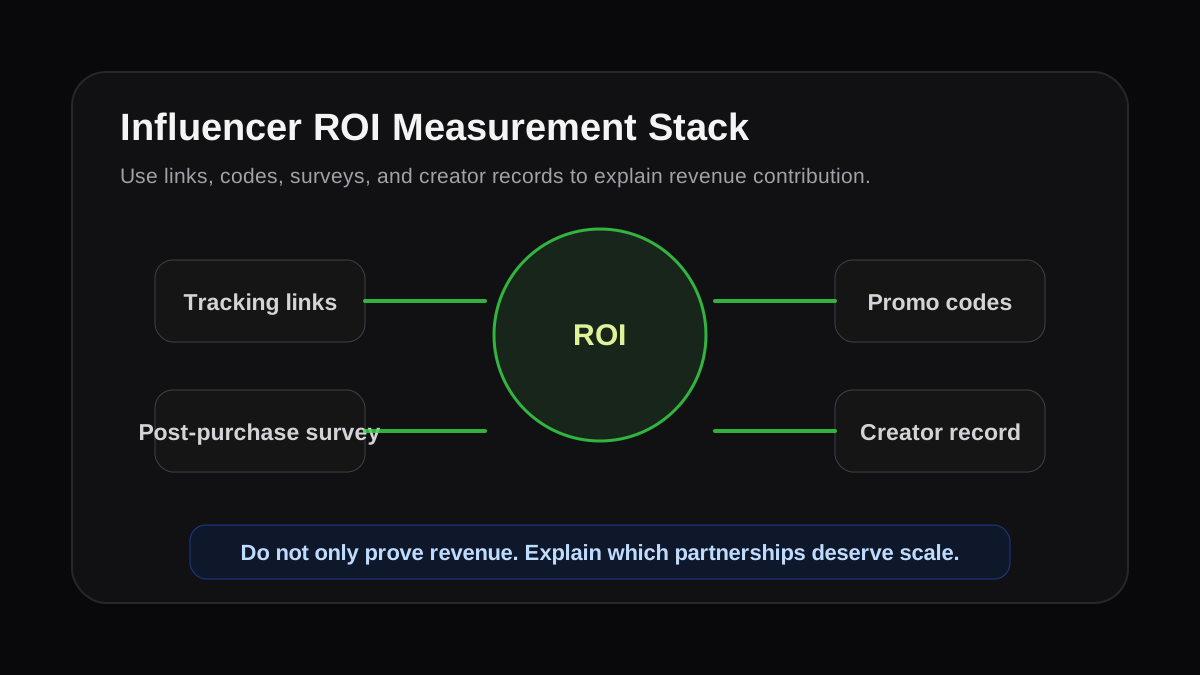
Influencer impact often happens outside the click. A buyer may watch a video, search the brand days later, see several creators before purchasing, or remember a promo code without using the original link. Bioby.ai's view is that ROI is not one perfect number. It is a measurement stack that connects tracking assets, creator records, cost definitions, and renewal decisions.
Define the business version of ROI first#
Different campaigns need different ROI definitions. Ecommerce teams may focus on order revenue, margin, refunds, and new customers. SaaS teams may care about qualified trials, activated accounts, pipeline influence, or sales feedback. Launch campaigns may value audience learning, content assets, and search demand before immediate purchase.
The basic formula can be revenue minus cost divided by cost, but that formula only works when both sides are defined. Cost includes creator fees, product, shipping, usage rights, amplification, tools, team time, and agency support. Return may include revenue, qualified leads, reusable assets, or high-quality customer insight.
Stack multiple signals#
A single measurement method leaves blind spots. UTM links capture click-path behavior, but miss delayed purchases and app-native behavior. Promo codes capture conversions when links fail, but can leak to coupon sites. Post-purchase surveys reveal dark social influence, but they are self-reported. Platform metrics explain content reaction, but not always business value.
A practical stack uses four layers: a unique link for each creator or asset, a unique code for each creator, post-purchase survey options, and platform plus site analytics. InfluencerDB notes that UTMs are attribution inputs, not ROI by themselves; teams still need cost, conversion, and value data.
When links, codes, and surveys disagree, investigate the customer journey instead of picking the number that looks best. Was the link hard to click? Did the code spread outside the creator's audience? Did the creator create trust that converted later through search?
Build creator-level scorecards#
Campaign totals are useful, but creator-level scorecards create decisions. A scorecard should include total cost, tracked visits, code redemptions, revenue or qualified actions, customer quality, comment quality, usage rights, approval reliability, payment status, and the next recommendation.
For high-consideration products, add lead quality, sales notes, pipeline stage, and customer fit. A creator with modest direct revenue may still be valuable if their audience asks qualified questions and their content becomes a paid asset. A creator with strong short-term sales may be less attractive if code leakage, refunds, or limited rights reduce true value.
Bioby.ai should connect these signals to the relationship record. ROI without creator context becomes a ranking table. ROI with context becomes a renewal, coaching, or budget-allocation decision.
Document the attribution window#
Every ROI number needs a time window. Impulse purchases may show results within days. Subscription and B2B products may require weeks or longer. A window that is too short penalizes education-focused creators. A window that is too long mixes in too many other channels.
A good report uses one primary view and one sensitivity note. For example: direct link and code results within 14 days as the primary view, plus 30-day survey mentions, branded search, or sales feedback as supporting context. Plain English's revenue-first stack makes a similar argument: links, codes, and surveys reduce blind spots when reconciled with clear rules.
Include margin and customer quality#
Revenue is not the same as return. A discount-heavy campaign may create orders with low margin. A creator may send customers who refund quickly. A B2B creator may send fewer leads but far more qualified accounts.
ROI reporting should include the quality of the outcome: new customer percentage, average order quality, refunds, activation, lead fit, or sales-stage movement. This prevents teams from overfunding creators who drive low-quality volume.
Creator memory matters here. If a creator consistently sends high-fit customers, that should influence future matching even if their immediate revenue looks smaller than a broader creator's result.
Report two numbers and one explanation#
For leadership, avoid presenting one final ROI number without context. Show a direct tracked result, a supporting influence signal, and a short explanation of caveats and next action.
For example: "Direct tracked revenue met 82% of target. Survey and branded search signals suggest creators influenced additional demand that converted through search. Recommendation: keep the creator segment, improve landing-page continuity, and negotiate paid usage rights for the top two assets."
This structure is more honest than pretending attribution is perfect. It also tells leadership what to change.
Add content rights to ROI#
Influencer ROI often ignores the value of reusable content. A creator may generate moderate direct revenue but produce an asset that can be edited into ads, landing pages, email, or sales enablement. That future value belongs in the decision.
Separate content into three groups: organic-only posts, content the brand can repost, and content that can enter paid media or the long-term asset library. The third group deserves special attention because it can reduce future creative production costs.
Use a minimum viable ROI dashboard#
Teams do not need a complex attribution model on day one. They need a consistent dashboard that can survive every campaign. Start with one row per creator and include total cost, tracked visits, code redemptions, attributed revenue or qualified actions, content-rights status, qualitative comment notes, and next action.
This minimum dashboard forces useful discipline. It separates spend from outcome, outcome from interpretation, and interpretation from decision. As the program matures, add margin, refunds, customer lifetime value, activation quality, sales-stage movement, or modeled attribution. But do not add complexity before the basics are reliable.
A simple dashboard also reduces argument. If every creator has a link, a code, a cost line, a rights line, and a renewal recommendation, teams can compare partnerships without reconstructing the campaign from screenshots and Slack messages.
Treat ROI as a decision system#
A campaign can produce a positive ROI number and still be a poor next investment. That happens when the result depends on one-off discounting, code leakage, a creator who will not grant rights, or operational effort the team cannot repeat. A campaign can also look weak on direct revenue while producing a strong next step: a new creator profile, a reusable ad asset, or evidence that a message does not work.
The right question is not only "was this profitable?" It is "what should change because of this result?" Scale, renegotiate, coach, retest, pause, or archive. That action should sit next to the ROI number.
Bioby.ai's role is to connect the number to the operating record. If a creator performed poorly because the link broke, that should not damage their score. If a creator performed well because the brand offered an unusually deep discount, that should be noted before scaling.
Common measurement failure modes#
The first failure mode is double-counting when links and codes both capture the same sale. The second is undercounting when users search later or buy through another channel. The third is ignoring refunds and margin. The fourth is treating all creators as if they had the same job. The fifth is measuring too late to fix broken links, weak landing pages, or missing disclosures.
A healthy ROI process includes pre-launch testing, live monitoring, end-of-window reporting, and post-campaign learning. Measurement should improve the next brief, not just decorate a final deck.
Use ROI to improve creator matching#
The best ROI process changes how the next creator shortlist is built. If educational creators consistently produce fewer immediate sales but higher-quality leads, that should shape the next campaign. If comedy creators generate reach but low-intent traffic, the team should know that too. ROI should feed back into matching criteria: audience quality, content format, offer fit, and collaboration reliability.
This is where Bioby.ai should be different from a static report. The system should remember not only that a creator performed well, but why. Was it the audience, the hook, the offer, the landing page, the posting time, or the creator's ability to answer comments? The next recommendation should be based on that operating memory.
Review the qualitative evidence#
Numbers explain part of performance, but creator partnerships also produce qualitative signals. Read the comments. Look for repeated objections, product-language that customers use naturally, questions about price or use case, and signs that the creator's audience understands the category. These details can explain why two creators with similar revenue deserve different next steps.
A creator who generates thoughtful comments may deserve another test with a stronger offer. A creator who drives clicks but confused questions may need a better brief. A creator whose audience repeats the brand's positioning in their own words may be creating value that will show up later in search, direct traffic, or sales conversations.
Final takeaway#
Influencer marketing ROI should reduce uncertainty and guide the next decision. Links, codes, surveys, platform data, and creator records all explain different parts of the result.
When ROI is connected to creator context, usage rights, approvals, and content quality, brands can see which partnerships deserve scale, which workflows need repair, and which creators should become long-term partners.
Keep reading this path#
This article is part of the same topic path. Useful next reads:
- What Does an Influencer Marketing Platform Do?
- How to Build an Influencer Marketing Strategy That Improves Every Campaign
- How Much Does Influencer Marketing Cost? Budget Beyond Creator Fees
- How to Track Influencer Marketing Campaigns Without Losing Creator Context