
How Much Does Influencer Marketing Cost? Budget Beyond Creator Fees
A practical influencer marketing budget guide for brands and agencies covering creator fees, usage rights, product seeding, amplification, team time, and campaign learning.
Influencer marketing costs more than a creator's quoted post fee. The real budget includes creator compensation, product seeding, shipping, content production, usage rights, exclusivity, paid amplification, tools, team time, approvals, reporting, and campaign learning. If a team only asks, "How much is one post?" it will underestimate the actual investment and miss the costs that determine whether the campaign can scale.
A better budgeting question is: what are we buying? Reach, content, trust, conversions, usage rights, or a long-term creator relationship? Bioby.ai's view is that influencer budgets should not be organized only around follower count and rate cards. They should be organized around whether the spend creates reusable creator knowledge, content assets, and measurable operating insight.
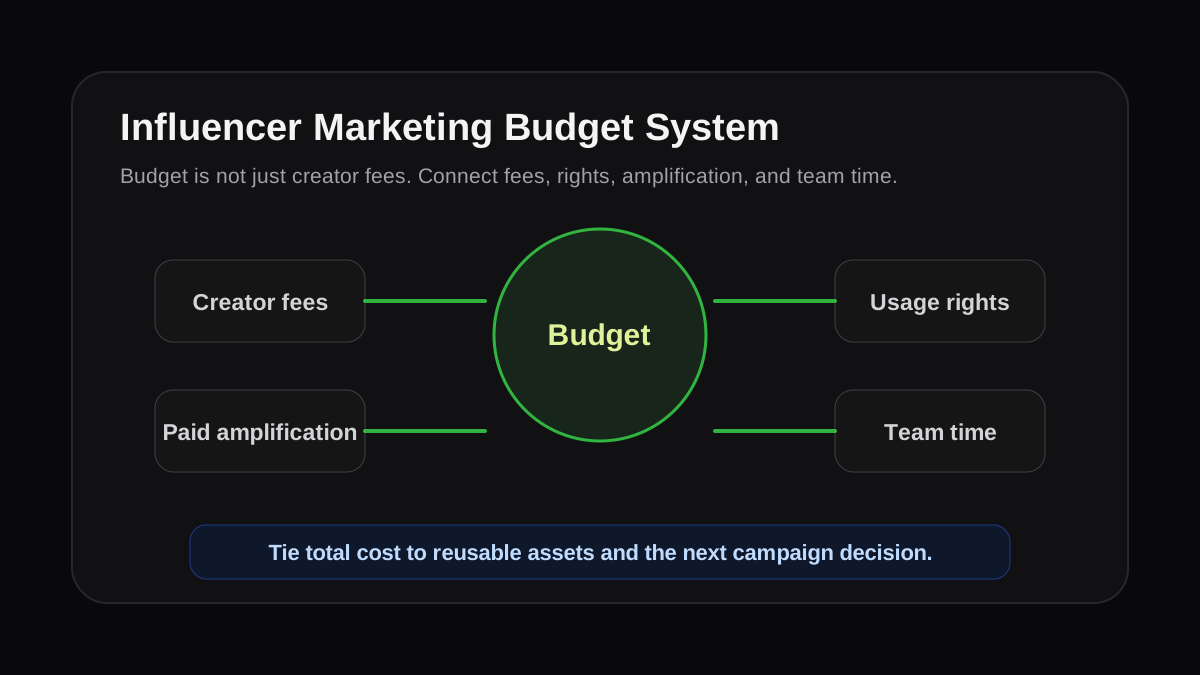
Separate the visible and hidden costs#
The visible cost is the creator fee: the amount paid for a Reel, TikTok, Story, YouTube integration, livestream, carousel, newsletter mention, or LinkedIn post. This fee varies by platform, format, category, production effort, timeline, and the creator's commercial maturity.
The hidden costs are often more important. Usage rights determine whether the brand can reuse the content beyond the original post. Product seeding and shipping can become meaningful when campaigns include many creators or international markets. Legal review, approval cycles, reporting, and payment processing consume team time. Paid amplification can turn a strong creator asset into a scalable ad, but only if rights and permissions are clear.
Hootsuite and other pricing guides note that campaign scope, usage rights, exclusivity, platform, audience size, engagement quality, and content type all shape pricing. For brands, the lesson is not to memorize a universal rate. The lesson is to build a cost model that matches the campaign decision.
Do not price creators by follower count alone#
Follower count affects price, but it should not decide value by itself. A large creator may create reach without buyer relevance. A smaller specialist may explain the product better, generate stronger comments, or produce content that the brand can reuse in paid channels.
A stronger budget model scores creators across audience fit, content quality, community trust, category relevance, reliability, production scope, and rights potential. For B2B, fintech, health, SaaS, or high-consideration products, explanation quality and audience intent can matter more than broad reach.
This is where Bioby.ai's relationship memory matters. The team should not only record what a creator costs. It should record why the creator was selected, what audience hypothesis they represent, what content role they play, and what happened after the campaign. Without that context, the next budget discussion starts from scratch.
Usage rights can change the economics#
A creator posting once on their own channel is not the same as a brand using that content in ads, landing pages, email, sales decks, or international campaigns. Usage rights should be negotiated before content performs, not after the team discovers a winning asset.
Budget for at least five rights questions: Can the brand repost the content? Can it run the content as paid media? For how long? On which platforms? Can the brand edit the content into shorter clips or new formats? If partnership ads, Spark Ads, or whitelisting are part of the plan, permissions and compensation should be written into the deal.
A more expensive creator with clear six-month paid usage rights may be more valuable than a cheaper creator whose content cannot be reused. Budget reviews should compare total asset value, not just posting cost.
Budget for execution risk#
Campaign waste often happens in execution. Products ship late. Drafts sit in approval. Links are not tested. Disclosure language is corrected after posting. Payments are delayed. These operational issues cost money even when they do not appear on the creator invoice.
A serious budget includes ownership for sourcing, outreach, negotiation, briefing, legal review, content approval, link testing, payment, and reporting. Agencies should also make client approval windows explicit; otherwise project management hours quietly expand.
Bioby.ai's operating perspective is to make those costs visible. If a campaign is blocked by approval or payment, the team should see it during execution, not discover it during the postmortem.
Start with a pilot budget#
For brands still learning the channel, a pilot budget is usually better than a large one-time bet. Instead of spending everything on a small number of high-reach creators, activate a controlled set across several creator profiles, content formats, and audience hypotheses.
A pilot budget should include creator fees, product and shipping, basic rights, tracking setup, a small amplification reserve, and reporting time. The goal is not to prove every assumption immediately. The goal is to learn which creator profile deserves the next budget.
This turns budget into a learning tool. The team can identify which creators explain the product clearly, which content drives qualified traffic, which rights should be negotiated earlier, and which workflow issues slow the campaign down.
Ask seven questions before approving spend#
Before approving influencer spend, ask seven questions. What are we buying: reach, content, trust, conversions, or relationship learning? What is included in the creator fee? Are usage rights included, and for how long? Do we need exclusivity or paid amplification rights? Who owns approval, tracking, payment, and reporting? What assets will remain after the campaign? What decision will this spend help us make next?
These questions prevent false comparisons. Two creators may quote the same price, but one offers only an organic post while the other offers clear rights, reliable workflow, and reusable content. Bioby.ai should help teams see that difference rather than treating all quotes as equal.
Use cost structure to shape the creator mix#
After setting the budget, do not divide it evenly across creators. Assign roles. Some creators should explain the product. Some should help the brand enter a specific community. Some should produce reusable content. Some budget should be reserved to amplify the strongest assets.
This makes the budget a portfolio, not a shopping list. A campaign can include a few trust-building specialists, several content-testing creators, and a smaller reserve for paid distribution. The mix depends on the business decision, not a generic rate table.
Build the budget from roles, not averages#
Averages can be useful for orientation, but they are dangerous as a planning tool. A creator who produces one polished launch video plays a different role from a creator who can answer comments for three days, a UGC creator who delivers ten ad variants, or a niche expert whose post becomes a sales enablement asset. Budget should follow roles.
A practical creator mix might include four roles. Explainers help the market understand the product. Trust builders bring credibility inside a niche community. Asset creators produce content the brand can test in paid channels. Revenue partners receive a mix of fee and performance incentive. Each role needs different compensation, rights, timelines, and success metrics.
This also prevents underfunding the work that makes campaigns reusable. If the brand spends everything on posting fees and leaves nothing for rights, reporting, or amplification, the campaign may create attention but no durable asset. If the brand spends only on content and no one owns creator relationships, the program will not compound.
Compare total cost per decision, not cost per post#
Cost per post is easy to compare, but it rarely reflects business value. A better unit is cost per decision. Did this spend help the team decide which creator profile works, which message resonates, which audience is worth expanding, or which asset deserves paid support?
For example, a $12,000 campaign with ten micro creators may produce enough evidence to identify two repeatable creator profiles and three reusable assets. A $12,000 single post from a larger creator may create more reach but less learning. Neither is automatically right. The right choice depends on whether the brand needs proof, content, credibility, or scale.
Bioby.ai should help teams preserve that learning. Budget reports should show not only spend and outcome, but also what changed because the campaign happened: which creators entered the relationship pipeline, which assets gained rights, and which hypotheses were retired.
Budget failure modes to avoid#
The first failure mode is buying reach without audience fit. The second is buying content without rights. The third is buying creators without allocating time for review, tracking, and payment. The fourth is buying a test but reporting it like a scaled program. The fifth is cutting the management layer so deeply that every campaign depends on manual heroics.
A good budget makes tradeoffs explicit. If the team cannot afford paid usage rights for every creator, choose which assets are most likely to need them. If the team cannot activate many creators, choose fewer but document the learning more carefully. If the team needs speed, reduce approval complexity before compressing creator timelines.
When a lower price is actually more expensive#
A low creator fee can become expensive if the partnership requires heavy rewriting, late approvals, unclear usage, or manual follow-up across several tools. The team may save on the post and lose time in coordination. That is why cost should include reliability. A creator who understands the brief, submits usable drafts, and grants clear rights may lower total campaign cost even when their quoted fee is higher.
Final takeaway#
Influencer marketing cost is not the price of a post. It is the full investment required to select, brief, approve, publish, track, pay, reuse, and learn from creator partnerships. The more clearly a team separates fees, rights, operations, and learning, the better it can decide where to spend next.
Bioby.ai's recommendation is simple: manage the cost behind the relationship, not only the quote. That is how every budget cycle improves the next creator match, workflow, and report.
Continue this topic path#
This article is part of the same topic path. Useful next reads:
- What Does an Influencer Marketing Platform Do?
- How to Build an Influencer Marketing Strategy That Improves Every Campaign
- How to Track Influencer Marketing Campaigns Without Losing Creator Context
- How to Measure Influencer Marketing ROI Without Trusting One Number
Sources#
Related Articles
What Does an Influencer Marketing Platform Do?
9 min read
A practical explanation of what influencer marketing platforms should help brands and agencies do across creator discovery, outreach, approvals, payments, rights, and reporting.
Read article →How to Build an Influencer Marketing Strategy That Improves Every Campaign
9 min read
A practical guide for brands building influencer marketing strategy around creator fit, briefs, approvals, usage rights, tracking, and repeatable learning.
Read article →How to Track Influencer Marketing Campaigns Without Losing Creator Context
11 min read
A practical guide to tracking influencer campaigns with clean links, creator records, approvals, reporting cadence, and Bioby.ai workflow context.
Read article →