
B2B and LinkedIn Influencer Marketing: Expert Trust, Employee Voices, and Pipeline Signals
A practical B2B influencer marketing guide covering LinkedIn creators, employee advocacy, thought leadership, CRM signals, and pipeline reporting.
B2B and LinkedIn influencer marketing should not copy consumer creator playbooks. It is less about broad reach and more about trusted voices shaping how buyers understand problems, compare options, and build internal confidence. The strongest B2B creators may be practitioners, customers, employees, advisors, operators, founders, or technical experts.
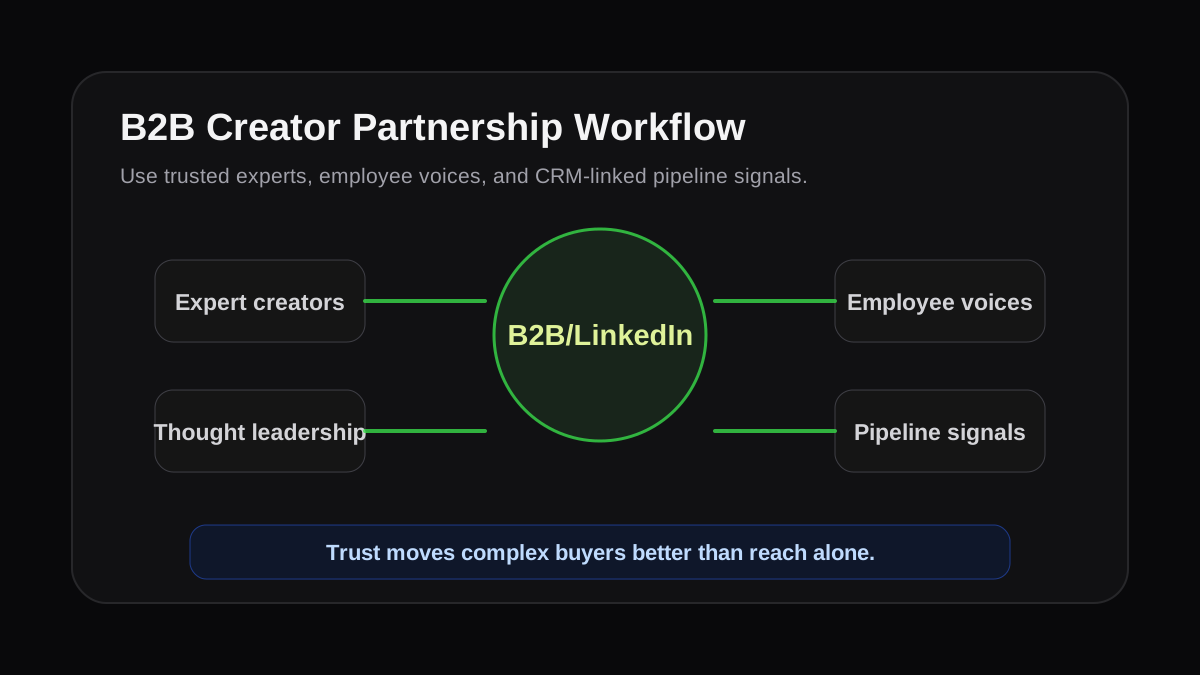
Trust matters more than reach#
B2B buyers are managing risk, budget, internal approval, and career credibility. They want to hear from people who understand the problem. A smaller expert audience can be more valuable than a larger generic audience.
LinkedIn's thought leadership research points to the same shift: buyers increasingly use human voices to make sense of complex categories. In B2B, the creator's credibility is the media channel.
Educate before selling#
B2B creator content should teach. Strong formats include problem breakdowns, workflow examples, procurement mistakes, case discussions, expert interviews, customer lessons, and category POVs. A post that reads like a brand ad will usually underperform because professional audiences can sense shallow promotion quickly.
Bioby.ai recommends using three voices together: external experts for credibility, internal employees for lived experience, and customers for proof. The combination is more persuasive than a brand account speaking alone.
Employee advocacy is a creator program#
Employee advocacy should not mean forcing employees to repost company announcements. It should help credible employees share real expertise: what customers ask, what projects reveal, what mistakes teams make, and what the market misunderstands.
Give employees prompts, coaching, and content pillars, not scripts. The strongest employee content sounds like a practitioner first and a company representative second.
Connect engagement to CRM#
B2B influencer reporting should include target-account engagement, comments from relevant job titles, sales-team feedback, demo conversations, influenced pipeline, and whether content helps explain the problem. Likes and impressions are not enough.
If a VP at a target account engages with an expert post, sales should know. If a prospect mentions a creator discussion during discovery, that should be recorded. Without CRM connection, B2B creator work remains a social metric instead of a revenue signal.
Build long-term partnerships#
B2B buying cycles are long. One post rarely creates enough trust. Consider 3- to 12-month expert partnerships, recurring LinkedIn posts, webinars, newsletter collaborations, YouTube interviews, or customer-led discussions. Repeated exposure builds familiarity and reduces perceived risk.
Final takeaway#
B2B and LinkedIn influencer marketing is people-led trust for complex decisions. Bioby.ai's recommendation is to connect experts, employees, customers, content, and CRM feedback into one relationship memory so creator activity supports pipeline, not only social visibility.
Start with the buying committee#
B2B creator selection should begin with the buying committee. Who influences the deal? The economic buyer, daily user, technical evaluator, legal team, security team, finance approver, partner ecosystem, or customer success leader? Each role cares about different risks and proof.
A technical buyer may want integration detail. A business leader may want efficiency and adoption evidence. An executive may want strategic risk framing. The right LinkedIn creator is the person whose audience includes the roles that matter.
Let expert voices have a point of view#
Professional creators are valuable because they can make judgments. If the brand removes every sharp edge, the content becomes a corporate message with a human face. Clear guardrails are needed, but the creator should be able to say when an approach works, when it fails, and who should avoid it.
That honesty builds trust. B2B buyers know no solution is universal. Specific caveats often make the recommendation more credible.
Build a trust ladder#
External experts create category attention. Employees provide lived operational experience. Customers provide proof. Together, they form a trust ladder: the expert makes the problem visible, employees make the solution understandable, and customers make the outcome believable.
Bioby.ai recommends recording which partners are strong for strategy, technical depth, customer stories, webinars, LinkedIn video, or sales enablement. Over time, this becomes a relationship map, not a list of one-off sponsored posts.
Bring sales into reporting#
If sales does not know which creator content is influencing target accounts, B2B influencer marketing stays trapped in a marketing dashboard. Sales can tell whether prospects mention the content, whether a point of view opens conversations, and which objections remain unresolved.
A useful B2B creator review includes marketing, sales, and customer success. The goal is not social activity. The goal is helping buyers understand the problem and move through the decision with more confidence.
Operating checklist before launch#
Before contracting a creator, define the content job, the approval owner, the required disclosure, the usage rights, the tracking method, and the reporting window. This sounds basic, but most creator programs break because one of these items is assumed rather than documented. The creator thinks the brand is buying a post. The media team later wants paid usage. Legal wants a different claim. The reporting team cannot connect the content to a campaign ID. None of these problems are creative problems. They are workflow problems.
Bioby.ai's operating principle is that the record should travel with the creator relationship. The team should know why a creator was selected, what audience they were expected to reach, what the brief asked them to do, what rights were granted, what changed during approval, and what signal came back after publication. That record turns a campaign into a reusable learning asset.
Creator evaluation scorecard#
A useful scorecard should include audience fit, content credibility, format skill, collaboration reliability, rights flexibility, and signal quality. Audience fit asks whether the creator reaches the people the brand actually needs. Content credibility asks whether the creator's recommendation would be believed. Format skill asks whether the creator is strong in the specific format being purchased. Collaboration reliability covers timelines, revisions, and responsiveness. Rights flexibility determines whether the content can become an asset. Signal quality measures whether comments, questions, clicks, or sales feedback create useful learning.
This scorecard prevents teams from overvaluing follower count. A smaller creator with a credible audience, clean communication, and usable rights may be more valuable than a larger creator who produces one impressive but isolated post.
Reporting questions that improve the next campaign#
The best reports do not only describe what happened. They help the team decide what to do next. After each campaign, ask which creator should be renewed, which content role worked, which platform generated the most useful questions, which claims confused the audience, which asset deserves paid amplification, and which rights should be bought upfront next time.
If the report cannot answer those questions, it may be visually polished but operationally weak. Influencer marketing improves when each campaign leaves behind cleaner judgment for the next campaign.
A practical example#
Imagine a brand launching a new workflow product. Instagram's job could be to show credible scenes of real teams using the product. TikTok's job could be to test short hooks such as saving meeting time, building a report quickly, or reducing manual coordination. YouTube's job could be to let a creator demonstrate the complete workflow from problem to result. LinkedIn's job could be to let an expert explain why teams are changing the old way of working.
All four channels are useful, but they are not doing the same work. Instagram creates visual proof. TikTok tests language. YouTube explains the full process. LinkedIn builds professional confidence. If the brand simply reposts the same ad everywhere, it misses the unique value of each channel.
This example also changes how the team should brief creators. The Instagram creator needs product context and visual do's and don'ts. The TikTok creator needs hooks, scenes, and permission to speak natively. The YouTube creator needs a real product walkthrough and enough time to understand it. The LinkedIn creator needs the business argument, customer context, and room to share an actual point of view.
How Bioby.ai thinks about channel work#
Bioby.ai does not treat influencer marketing as a list of posts to purchase. It treats it as a relationship and learning system. Each platform reveals a different kind of signal. Instagram reveals visual trust. TikTok reveals customer language. YouTube reveals depth of understanding. LinkedIn reveals professional consensus and buying committee friction.
When those signals stay connected, the team can make better decisions next time: which creators to renew, which rights to negotiate, which claims need clearer proof, which content should be amplified, and which channel should not receive more budget yet. That is the difference between running campaigns and building an influencer marketing capability.
When not to use this channel#
A channel should be postponed when the team cannot support the workflow it requires. If there is no clear approver, no usage-rights plan, no disclosure guidance, no tracking setup, or no owner for post-launch review, the platform will not fix the underlying problem. It may only make the problem more visible.
In that case, start smaller. Run a controlled test with a few creators, document what happened, and expand only after the team understands which signal it is trying to learn from. Good influencer marketing is not only creative judgment. It is operational readiness.
The same negative evidence should be saved for future planning. Knowing why a channel did not fit is as useful as knowing why a creator performed well, because it keeps the next budget discussion grounded in observed behavior rather than preference or trend anxiety.
For planning purposes, this negative evidence should become part of the creator profile. A creator who was not right for one product may still be right for a different message, format, or buying stage. Keeping that context prevents teams from making blunt judgments like "good creator" or "bad creator" when the real issue was role fit.
Continue this topic path#
This article is part of the same topic path. Useful next reads:
- How to Choose Influencer Marketing Channels: Instagram, TikTok, YouTube, or LinkedIn
- Instagram Influencer Marketing: Reels, Stories, Partnership Ads, and Rights
- TikTok Influencer Marketing: Short-Form Testing, Spark Ads, and Social Commerce
- YouTube Influencer Marketing: Long-Form Explainers, Shorts, and Evergreen Rights
Sources#
Related Articles
How to Choose Influencer Marketing Channels: Instagram, TikTok, YouTube, or LinkedIn
9 min read
A practical channel strategy guide for brands deciding where influencer marketing should run across visual trust, short-form testing, long-form education, and B2B pipeline influence.
Read article →Instagram Influencer Marketing: Reels, Stories, Partnership Ads, and Rights
8 min read
A practical Instagram influencer marketing guide covering Reels, Stories, Collab posts, Partnership Ads, disclosures, usage rights, and reporting.
Read article →TikTok Influencer Marketing: Short-Form Testing, Spark Ads, and Social Commerce
8 min read
A practical TikTok influencer marketing guide covering creator fit, native short video, Spark Ads authorization, disclosure, and conversion tracking.
Read article →