
YouTube Influencer Marketing: Long-Form Explainers, Shorts, and Evergreen Rights
A practical YouTube influencer marketing guide covering long-form integrations, Shorts, paid promotion labels, creator boosts, and evergreen content rights.
YouTube influencer marketing works best when the product needs explanation, trust, and shelf life. Compared with short-form channels, YouTube's value is not only first-week views. It is the creator's ability to explain a problem and keep that explanation discoverable over time.
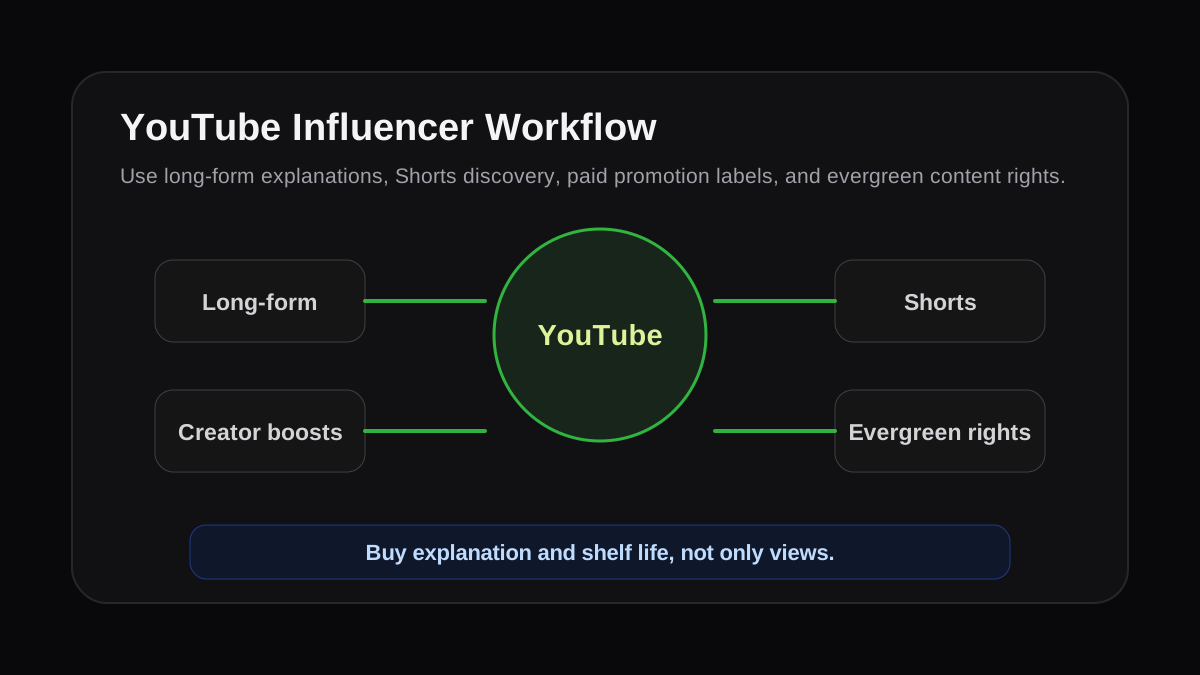
Long-form content supports complex decisions#
Long-form YouTube is useful for reviews, tutorials, comparisons, technical demos, case breakdowns, and category education. SaaS, consumer electronics, education, finance tools, and B2B services often need this type of explanation because buyers want context before action.
Briefs should define integration placement, minimum mention length, claims to avoid, required links, disclosure, and whether the creator can share honest limitations. Too much scripting reduces trust. No guardrails increases risk.
Shorts can create discovery#
YouTube Shorts can introduce a product or topic to a wider audience, but Shorts should not be expected to carry the full educational burden. Shorts can tease a long-form review, test a message, or create repeated exposure.
The best YouTube programs connect Shorts and long-form: Shorts drive discovery, while long-form content carries the explanation and evergreen value.
Paid promotion labels matter#
YouTube requires creators to identify paid promotion, sponsorship, or product placement. Brands are also responsible for legal disclosure obligations in their markets. For video content, a visible or verbal disclosure is often stronger than relying only on description text.
Brands should store final video links, descriptions, disclosure status, publish dates, and approved tracking links. Evergreen content may need future review if claims, pricing, or product positioning changes.
Rights last longer on YouTube#
Because YouTube content can keep performing through search and recommendations, usage rights matter. Brands may want to quote the video in sales emails, embed it on landing pages, cut segments into paid ads, or use it in customer education.
The contract should define editing rights, paid usage, duration, cross-channel use, and whether the creator can remove the content. A moderately performing video with strong explanation may be more valuable than a high-view asset with little buyer intent.
Final takeaway#
YouTube is best when the brand needs explanation, credibility, and long-term content value. Bioby.ai recommends treating YouTube partnerships as durable creator assets: record what the creator explained, where the content can be used, and how it supports sales, education, and future campaigns.
Brief around the explanation#
The biggest waste in YouTube influencer marketing is treating a long-form video as a longer ad slot. The brief should start with the audience problem. What does the buyer not understand yet? What alternatives are they comparing? What risks are they worried about? What demo or proof would make the product easier to evaluate?
Creators are valuable because they can turn complex topics into watchable explanations. The brand should provide facts, constraints, assets, and claims guidance, not a rigid script.
Integration placement matters#
The location of a sponsorship inside a video affects trust. A pre-roll style mention can work when the product is highly relevant to the topic, but it can feel intrusive when the connection is weak. A mid-video integration often works better when the product appears as part of the problem-solving flow.
Brands should ask why the viewer would accept the integration at that moment. The best integrations feel like part of the content. The weakest feel pasted in.
Use a longer reporting window#
YouTube does not end after the first week. Search, recommendations, external shares, and sales reuse can keep a video alive for months. Reporting should include 30-day, 90-day, and longer-term views of performance.
Useful signals include watch time, retention around the integration, click quality, comment questions, sales-team usage, and whether the video keeps answering buyer questions. For B2B and high-consideration products, the value may be repeated evaluation, not instant purchase.
Manage evergreen risk#
Evergreen content is powerful, but it can also preserve outdated claims. If pricing, features, positioning, or compliance language changes, old videos may continue to circulate. Keep records of claims, links, publish dates, and usage contexts so the team knows when to update, comment, or stop amplifying an asset.
Bioby.ai treats YouTube partnerships as long-term asset management. The longer the content can live, the more important the operating record becomes.
Operating checklist before launch#
Before contracting a creator, define the content job, the approval owner, the required disclosure, the usage rights, the tracking method, and the reporting window. This sounds basic, but most creator programs break because one of these items is assumed rather than documented. The creator thinks the brand is buying a post. The media team later wants paid usage. Legal wants a different claim. The reporting team cannot connect the content to a campaign ID. None of these problems are creative problems. They are workflow problems.
Bioby.ai's operating principle is that the record should travel with the creator relationship. The team should know why a creator was selected, what audience they were expected to reach, what the brief asked them to do, what rights were granted, what changed during approval, and what signal came back after publication. That record turns a campaign into a reusable learning asset.
Creator evaluation scorecard#
A useful scorecard should include audience fit, content credibility, format skill, collaboration reliability, rights flexibility, and signal quality. Audience fit asks whether the creator reaches the people the brand actually needs. Content credibility asks whether the creator's recommendation would be believed. Format skill asks whether the creator is strong in the specific format being purchased. Collaboration reliability covers timelines, revisions, and responsiveness. Rights flexibility determines whether the content can become an asset. Signal quality measures whether comments, questions, clicks, or sales feedback create useful learning.
This scorecard prevents teams from overvaluing follower count. A smaller creator with a credible audience, clean communication, and usable rights may be more valuable than a larger creator who produces one impressive but isolated post.
Reporting questions that improve the next campaign#
The best reports do not only describe what happened. They help the team decide what to do next. After each campaign, ask which creator should be renewed, which content role worked, which platform generated the most useful questions, which claims confused the audience, which asset deserves paid amplification, and which rights should be bought upfront next time.
If the report cannot answer those questions, it may be visually polished but operationally weak. Influencer marketing improves when each campaign leaves behind cleaner judgment for the next campaign.
A practical example#
Imagine a brand launching a new workflow product. Instagram's job could be to show credible scenes of real teams using the product. TikTok's job could be to test short hooks such as saving meeting time, building a report quickly, or reducing manual coordination. YouTube's job could be to let a creator demonstrate the complete workflow from problem to result. LinkedIn's job could be to let an expert explain why teams are changing the old way of working.
All four channels are useful, but they are not doing the same work. Instagram creates visual proof. TikTok tests language. YouTube explains the full process. LinkedIn builds professional confidence. If the brand simply reposts the same ad everywhere, it misses the unique value of each channel.
This example also changes how the team should brief creators. The Instagram creator needs product context and visual do's and don'ts. The TikTok creator needs hooks, scenes, and permission to speak natively. The YouTube creator needs a real product walkthrough and enough time to understand it. The LinkedIn creator needs the business argument, customer context, and room to share an actual point of view.
How Bioby.ai thinks about channel work#
Bioby.ai does not treat influencer marketing as a list of posts to purchase. It treats it as a relationship and learning system. Each platform reveals a different kind of signal. Instagram reveals visual trust. TikTok reveals customer language. YouTube reveals depth of understanding. LinkedIn reveals professional consensus and buying committee friction.
When those signals stay connected, the team can make better decisions next time: which creators to renew, which rights to negotiate, which claims need clearer proof, which content should be amplified, and which channel should not receive more budget yet. That is the difference between running campaigns and building an influencer marketing capability.
When not to use this channel#
A channel should be postponed when the team cannot support the workflow it requires. If there is no clear approver, no usage-rights plan, no disclosure guidance, no tracking setup, or no owner for post-launch review, the platform will not fix the underlying problem. It may only make the problem more visible.
In that case, start smaller. Run a controlled test with a few creators, document what happened, and expand only after the team understands which signal it is trying to learn from. Good influencer marketing is not only creative judgment. It is operational readiness.
The same negative evidence should be saved for future planning. Knowing why a channel did not fit is as useful as knowing why a creator performed well, because it keeps the next budget discussion grounded in observed behavior rather than preference or trend anxiety.
For planning purposes, this negative evidence should become part of the creator profile. A creator who was not right for one product may still be right for a different message, format, or buying stage. Keeping that context prevents teams from making blunt judgments like "good creator" or "bad creator" when the real issue was role fit.
For YouTube specifically, this context also helps the brand decide whether to refresh a link, request a follow-up Short, sponsor another integration, or retire the asset when the product message changes.
Continue this topic path#
This article is part of the same topic path. Useful next reads:
- How to Choose Influencer Marketing Channels: Instagram, TikTok, YouTube, or LinkedIn
- Instagram Influencer Marketing: Reels, Stories, Partnership Ads, and Rights
- TikTok Influencer Marketing: Short-Form Testing, Spark Ads, and Social Commerce
- B2B and LinkedIn Influencer Marketing: Expert Trust, Employee Voices, and Pipeline Signals
Sources#
Related Articles
How to Choose Influencer Marketing Channels: Instagram, TikTok, YouTube, or LinkedIn
9 min read
A practical channel strategy guide for brands deciding where influencer marketing should run across visual trust, short-form testing, long-form education, and B2B pipeline influence.
Read article →Instagram Influencer Marketing: Reels, Stories, Partnership Ads, and Rights
8 min read
A practical Instagram influencer marketing guide covering Reels, Stories, Collab posts, Partnership Ads, disclosures, usage rights, and reporting.
Read article →TikTok Influencer Marketing: Short-Form Testing, Spark Ads, and Social Commerce
8 min read
A practical TikTok influencer marketing guide covering creator fit, native short video, Spark Ads authorization, disclosure, and conversion tracking.
Read article →