
How to Choose an Influencer Marketing Agency Without Losing Your Creator Memory
A practical guide for brands evaluating influencer marketing agencies across creator vetting, workflow, rights, reporting, contracts, and handoff.
Choosing an influencer marketing agency should not start with a creator roster. It should start with a business question: can this partner help your team find the right creators, move campaigns through approvals, manage usage rights, report outcomes transparently, and leave the brand smarter after every campaign?
Many brands treat an agency as outsourced execution. That can work, but only if the brand does not lose the creator memory: why creators were selected, what was negotiated, which content rights were secured, how performance was measured, and which relationships should continue. Bioby.ai's view is that agencies can accelerate execution, but the brand should still own the learning system.
Start with the job you need the agency to do#
Agencies solve different problems. Some are valuable because they have deep creator relationships in a category. Some are strong at campaign operations. Some bring compliance infrastructure, paid amplification, analytics, or multilingual market coverage. The wrong evaluation happens when a brand asks every agency the same generic question: "Who do you know?"
Instead, define the job. Do you need faster creator discovery? Better brand safety? More reliable content approvals? Stronger reporting for leadership? Support across TikTok, Instagram, YouTube, and LinkedIn? A full-service launch partner? The agency's strengths should match that job.
If your team already knows creators but cannot manage approvals and reporting, a relationship-heavy agency may not solve the real problem. If your team lacks category knowledge, a generalist agency with a big roster may not be enough.
Ask how creators are selected#
A serious agency should be able to show its selection process. How does it define audience fit? How does it evaluate engagement quality? How does it detect suspicious growth or low-quality comments? How does it assess past brand partnerships? How does it decide whether a creator can explain your product?
Enterprise agency guidance from Influencer Marketing Hub and other sources emphasizes that brands need systematic vetting, not follower-count sorting. Ask for a sample shortlist with reasoning attached: audience fit, content role, safety signals, pricing logic, previous partnership behavior, and known risks.
Bioby.ai recommends preserving these selection reasons inside the brand's own system. After the campaign, the team should compare the original hypothesis with the actual result. That is how creator selection improves.
Evaluate the approval workflow#
Influencer campaigns often fail in approvals, not discovery. Briefs are vague. Feedback arrives too late. Legal review happens after creative is already produced. Disclosure requirements are unclear. Links and codes are not tested before publishing.
Ask the agency to describe the exact workflow: creator submission, initial review, feedback, revision, final approval, publishing, and live checks. Who comments? Who approves? Which content types require legal review? How many revision rounds are included? Where are approval records stored?
InfluenceFlow's workflow guidance treats approval as a structured process, not a casual email thread. Brands should use the same lens. If an agency cannot explain how it handles a health claim, a missing disclosure, or a delayed client approval, it may struggle under real campaign pressure.
Demand reporting that informs the next decision#
Many agency reports look polished but stop at reach, engagement, screenshots, and creator lists. That is not enough. A useful report explains what to do next: renew, renegotiate, retest, amplify, pause, or archive.
Ask about attribution methodology. Does the agency use unique links, codes, pixels, platform data, post-purchase surveys, or sales feedback? Does it separate organic creator activity from paid amplification? Does it explain attribution gaps instead of pretending everything is measurable?
A strong report should connect creator performance, content rights, audience quality, workflow issues, and next-campaign recommendations. The agency should not only summarize the last campaign. It should improve the next one.
Put rights and handoff into the contract#
Agency contracts should cover content ownership, usage duration, editing rights, paid media rights, whitelisting or partnership ad permissions, and what happens when the contract ends. They should also clarify creator relationship continuity and data export.
If the best-performing creators, content assets, and campaign data cannot be used after the agency relationship ends, the brand may lose the most valuable part of the program. Agencies can manage relationships, but brands should not let all relationship history disappear into an external black box.
Plan the exit before you sign. That does not mean expecting failure. It means protecting the brand's long-term creator operating system.
Run a small process test#
Before signing a long engagement, consider a narrow test. Give the agency a real target audience and product scenario. Ask for a shortlist of 10 to 20 creators with selection reasons, risks, content roles, and a draft workflow.
This reveals more than a sales deck. Does the agency ask smart questions? Does it surface rights and compliance issues early? Does it explain tradeoffs? Does it make every creator sound perfect, or does it show judgment?
The process test also reveals communication quality. A strong agency can make decisions clearer, not just deliver a spreadsheet.
Red flags to watch#
Be careful when an agency emphasizes access but cannot explain matching. Be careful when reporting focuses only on impressions. Be careful when compliance answers are vague. Be careful when usage rights are discussed verbally but not written down. Be careful when the agency refuses data export or handoff. Be careful when it guarantees sales without explaining attribution.
None of these automatically disqualifies an agency, but they require deeper questioning. Good agencies are not afraid of transparency because transparency makes their execution value visible.
Use a five-part scorecard#
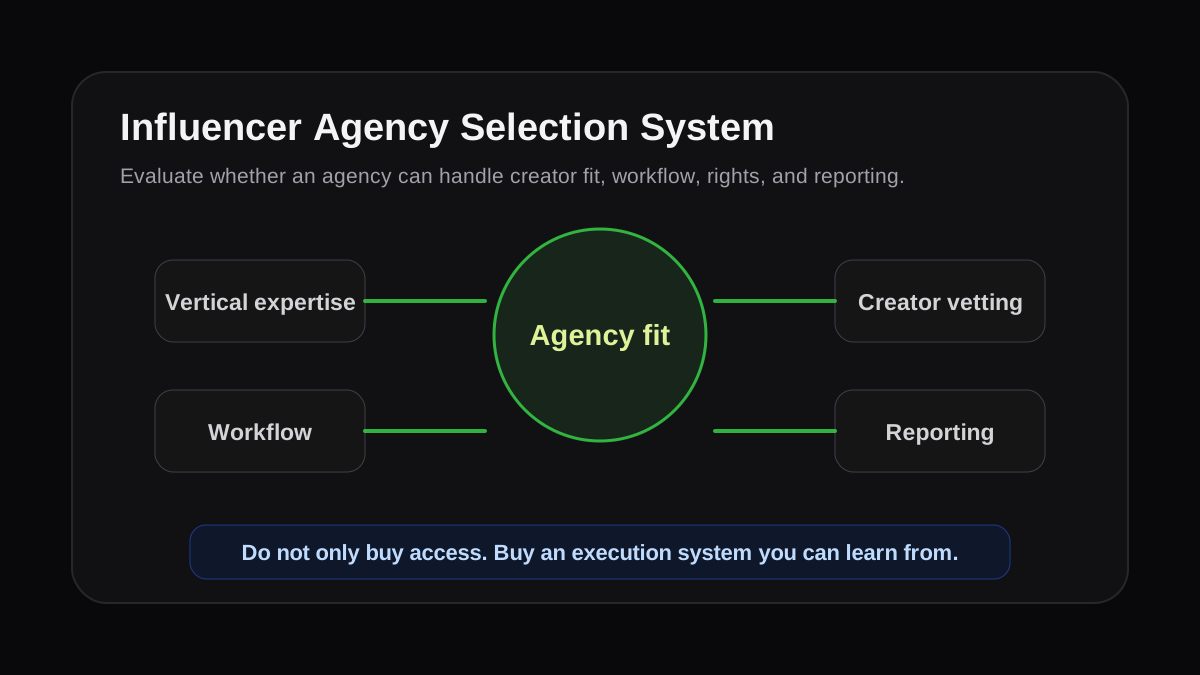
Evaluate agencies across creator fit, workflow reliability, compliance and safety, rights management, and reporting transparency. Give each dimension a score and require evidence: a sample shortlist, an approval process, contract language, a report sample, and a post-campaign learning structure.
A creative agency with weak reporting may be useful for a launch, but not for a repeatable creator program. An operationally strong agency with limited creative strategy may pair well with an internal brand team. The right partner depends on the job.
Agency and platform are not the same choice#
Brands often frame the decision as agency versus platform. In practice, mature teams often need both. An agency brings human judgment, category experience, creative taste, and negotiation support. A platform gives the brand records, workflow visibility, rights tracking, reporting continuity, and internal ownership.
If everything stays inside the agency, the brand may move faster for one campaign but learn less over time. If everything stays inside a tool without an accountable operator, the brand may still lack time and judgment. The strongest setup is usually a shared workflow: the agency executes and advises, while the brand keeps the system of record.
Bioby.ai is built around that second layer of memory. It lets a team keep creator context, approvals, rights, payments, and outcomes visible even when agencies, internal owners, or campaign priorities change.
Review how the agency handles creator relationships#
Ask whether creators are treated as media inventory or as relationship partners. The difference appears in small details. Does the agency personalize outreach? Does it explain why a creator is a fit? Does it pay on time? Does it preserve past communication? Does it avoid repeatedly asking the same creator for information already provided?
Creator relationships compound. A creator who had a clean first experience is more likely to accept a second campaign, grant useful rights, provide better feedback, and collaborate on a stronger brief. If an agency burns relationships with slow payment or generic outreach, the brand pays that cost later.
Decide what success looks like after 90 days#
Before hiring an agency, define what should be true after the first 90 days. It may be a validated creator profile, a repeatable approval workflow, a shortlist of renewal candidates, a content-rights library, or a leadership report that makes budget decisions easier.
This prevents a vague relationship where every month feels busy but nothing compounds. A good agency should be able to work toward an operating milestone, not just a deliverable list.
Ask for the raw operating view#
A polished case study is useful, but the operating view is more revealing. Ask to see a sample campaign tracker, a rights tracker, an approval log, a creator feedback note, and a weekly update format. These artifacts show how work actually moves. If an agency cannot show how it tracks decisions, it may be relying on individual heroics instead of a repeatable system.
Final takeaway#
The best influencer marketing agency is not the one with the longest creator list. It is the one that helps your team choose better, execute cleaner, protect rights, explain performance, and learn faster.
Bioby.ai's recommendation is to let agencies add judgment and execution speed while keeping the brand's creator memory intact. That is how each campaign makes the next one easier to run.
Continue this topic path#
This article is part of the same topic path. Useful next reads:
- Influencer Marketing Brand Safety: From Creator Vetting to Live Monitoring
- How to Use First-Party Data for Influencer Marketing Creator Matching
- How AI Helps Identify Influencers Without Replacing Human Judgment